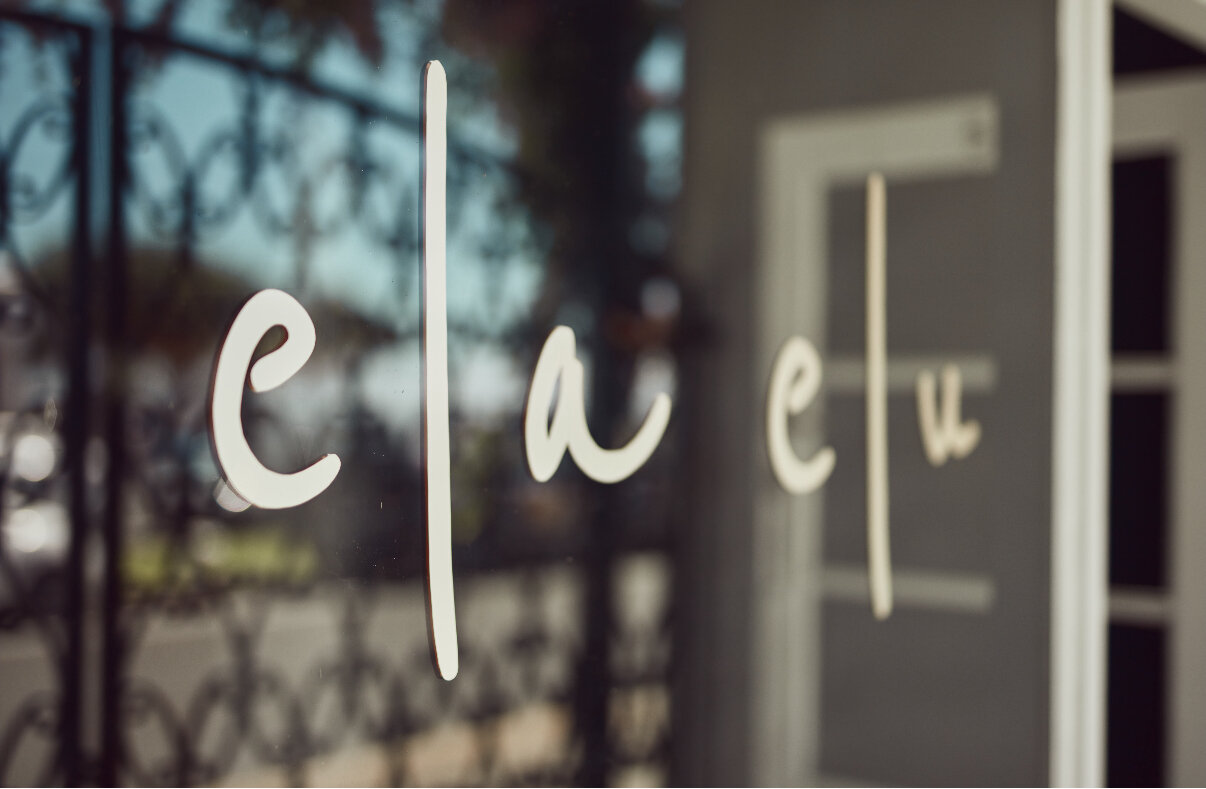
There is a town on the Queensland coast where the road bends inland from the headland and the salt comes off the surf and settles on every window facing east. It is the kind of place where the shopkeepers know the dog before they know the owner, and where, for the last five years, a single designer has been making wedding gowns by hand in a ground-floor studio below a 70 year old apartment building.
Her name is Alana McBain. The atelier is called Ela Elu. To find it you walk past the surf club, past the Salt Mill cofee shop, past the small park where the lorikeets fight each evening, and turn left at the frangipani tree. The Parisian gates are unmarked. You knock on the door.
I. The proposition
The proposition of Ela Elu is small and specific. There is one designer who is also the seamstress. There is a front of house, Narelle, who is Alana's sister and who handles the appointments, the calls, the brides who arrive early and the ones who arrive flushed and apologising for the traffic on the M1. There is no buyer, no production line, no licensing. Each gown is drawn from a single conversation with the woman who will wear it, and made in the room behind the door you knocked at.
This is, by the standards of the modern bridal industry, almost wilfully inefficient. The industry has spent twenty years moving in the opposite direction — toward digital fittings, made-to-order in three weeks, gowns shipped from a factory in Suzhou and adjusted on arrival. Ela Elu has gone the other way. A first consultation is followed by a toile, a calico mock-up cut from the brides own measurements and fitted to her body before a single panel of silk is touched. Then comes the blank gown — the dress made up in its final fabric but unembellished — and only then, after a second fitting, does the embellishment begin.
The embellishment is the slowest part. French lace selected by hand from a small list of mills in Calais. Silk georgette washed and drawn before cutting. Hundreds of seed pearls, sometimes thousands, placed one after the next by women who do this work because they cannot do it any other way. The hours are not counted. The hours are simply spent.
II. The town
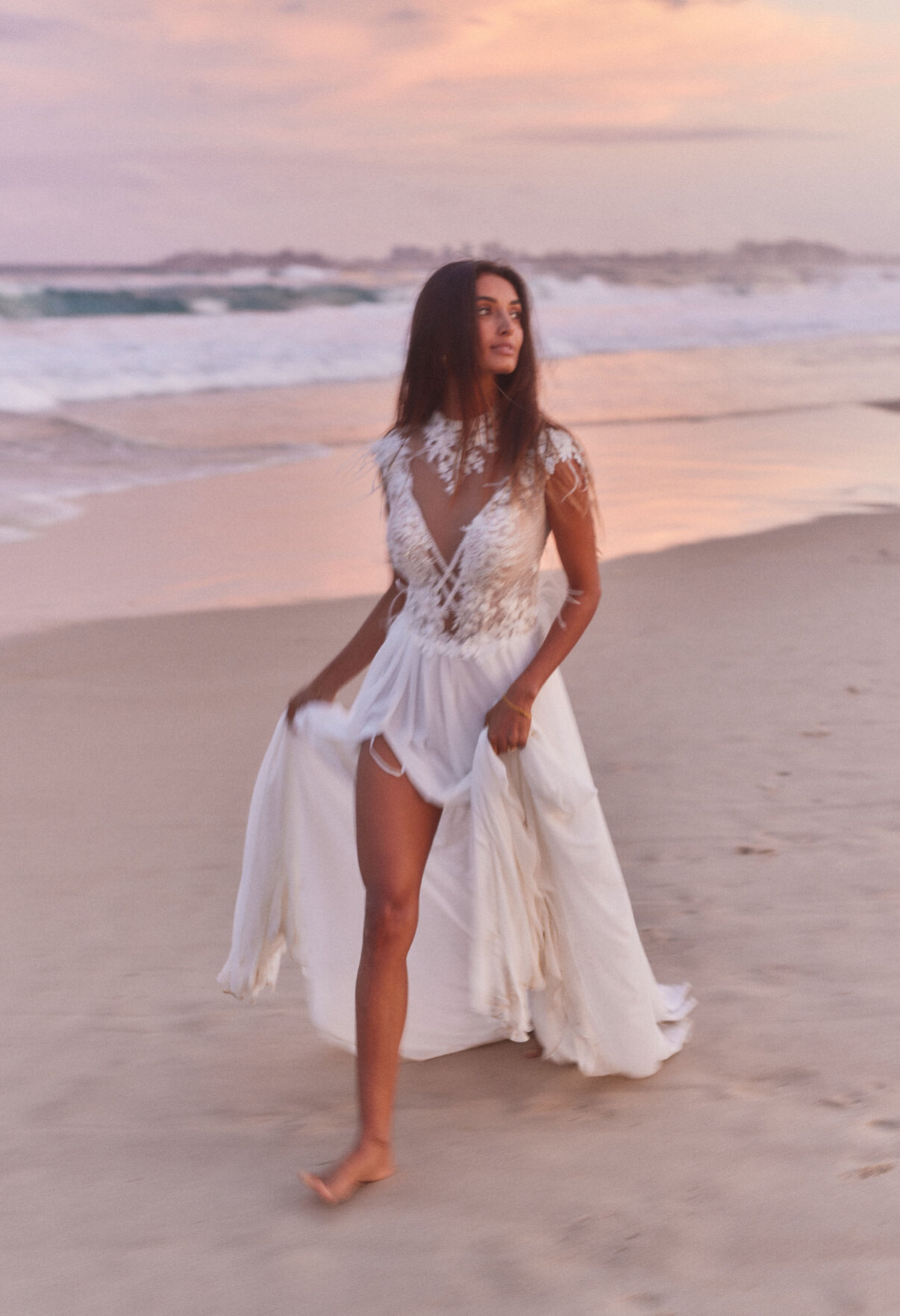
Currumbin is not the obvious place to keep a couture house. It is a stunning little surf town. The headland sits to the south and the creek runs to the north and the gowns Ela Elu makes have, more often than not, been worn by women married within forty kilometres of the studio door — on the sand at Tallebudgera, in the gardens at Kingscliff, under the pandanus at Cabarita.
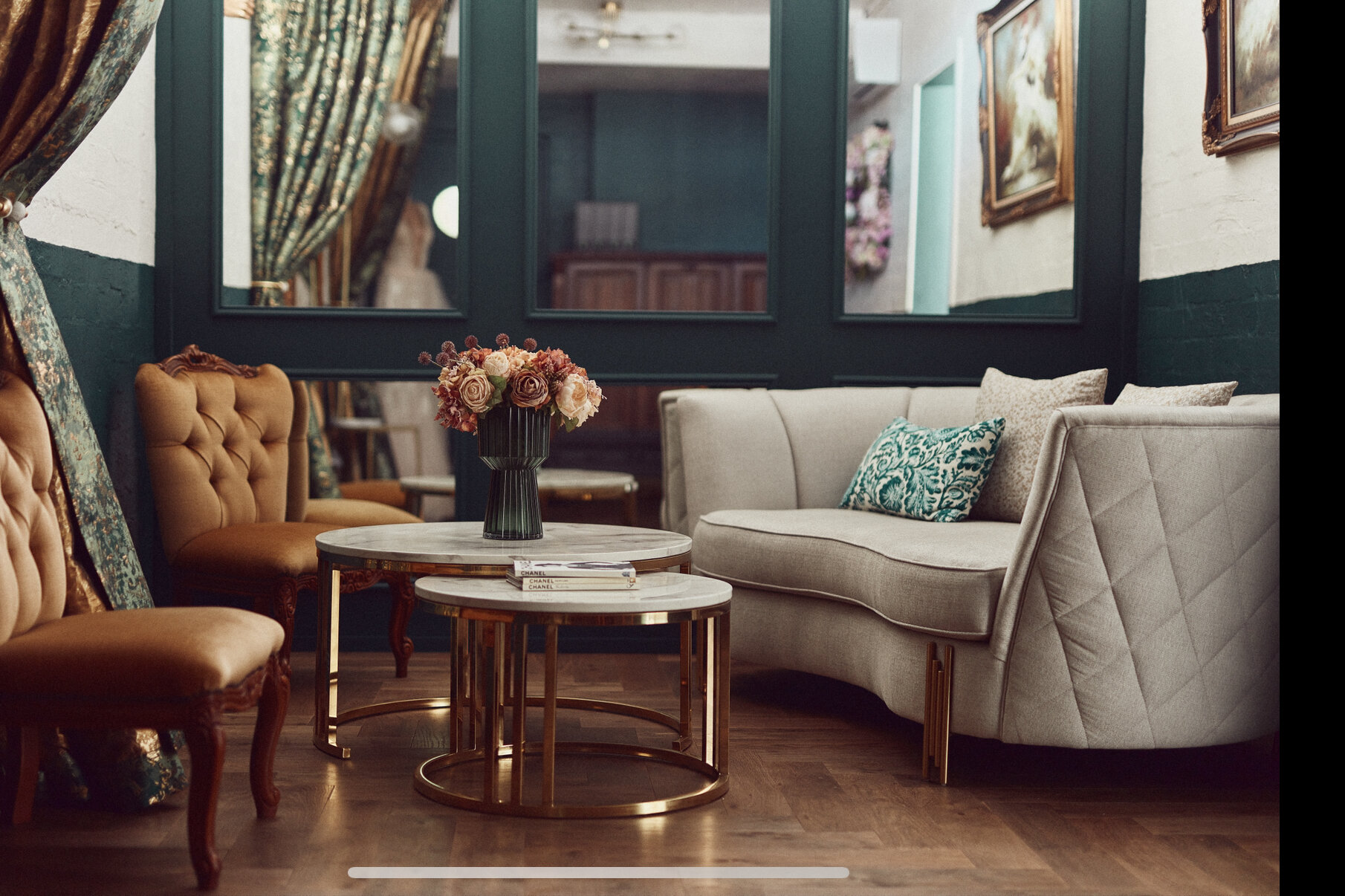
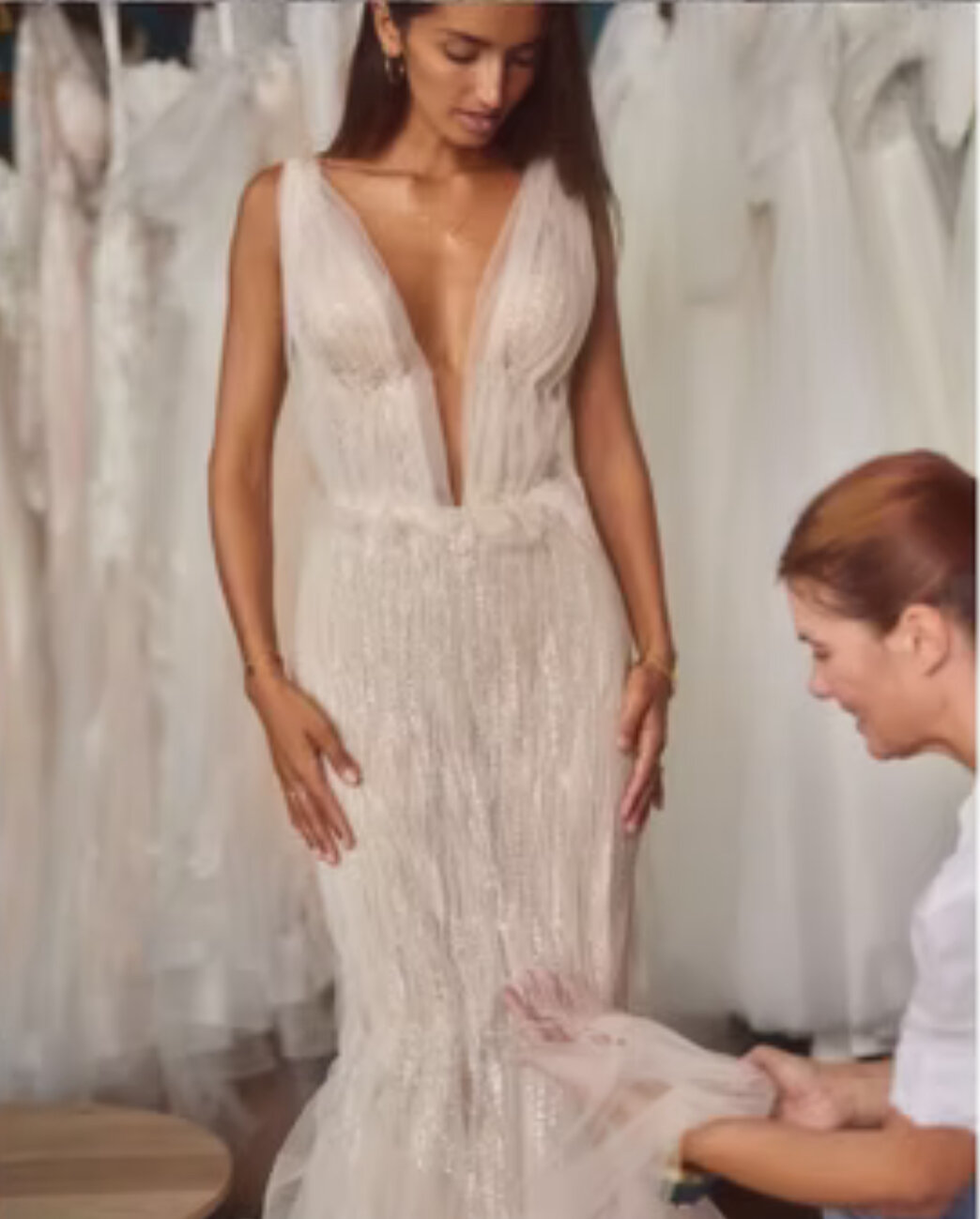
But the longer you spend in the atelier the more the location makes sense. The light is extraordinary — afternoon light that comes off the water and turns the workroom the colour of unbleached linen for about an hour every day. The pace is slower than a city pace. The brides who come here come because they have already decided not to do the thing the city brides do. They have decided to take their time.
And the building itself has a story now. Last year the renovation of the upper floors began — the residences above the shopfront converted, the upper floors carefully restored, the architect Richard Erwin engineering a new structure that threads through the original 1950s skeleton without touching a beam. The result is Houston Currumbin, a four-key beachfront residence on the floors above the atelier. The two operations now share a doorway. Brides who travel from Sydney or Singapore can be fitted in the morning and sleep in the penthouse the same night. It was not the plan, originally. But like most of the best things on the Gold Coast, it happened slowly, and then suddenly.
III. The hand
What is striking about Alana McBain is not what you expect it to be. She is not theatrical. She does not perform the role of the designer. The first time we visited the atelier she was sitting at the work table with a tape measure looped over her shoulder, sketching on butcher's paper, drinking a cup of tea that had gone cold an hour earlier. She did not look up when we came in. She finished the line she was drawing, then she did.
"I draw from the conversation," she said, when we asked. "Never from the catalogue. The first appointment is just talking — what she wears now, what she will not wear, where she is getting married, what her mother wore, whether her mother is alive. By the end of the appointment I have a drawing. Not a finished drawing. But a drawing."
The drawings are kept. They are pinned to a corkboard behind the work table — hundreds of them, organised by season, the earliest dating back to the founding of the house in 2020. A few of them have a small red mark in the corner. We asked what the red mark meant. "It means she came back," Alana said. "Sometimes for her sister. Sometimes for her daughter. Once, just once, for herself again."
IV. The collections
Ela Elu produces three small ready-to-wear collections each year, named after gemstones — Pearl, Garnet, Peridot — and a steady stream of bespoke commissions. The ready-to-wear gowns are made in the atelier, in editions of no more than twelve. The bespoke commissions are made in editions of one.
The price is not advertised. Brides who ask are told the truth — that a bespoke gown will sit somewhere between the cost of a small car and a large one, and that the deposit is non-refundable, and that there is a waiting list. The waiting list is currently eleven months long. It has been longer.
The bespoke process runs in five steps, and the names of the steps have not changed since the first year. Design Consultation. Toile Fitting. Blank Gown Fitting. Embellishment. Final Unveiling. From the first appointment to the final unveiling is, on average, eighteen weeks. Not because anyone is counting, but because that is the time a gown of this kind takes, and the atelier has stopped pretending it takes any less. The unveiling is the only one of the five that the bride does not see the inside of — the gown is finished in the workroom and presented, on a tailor's dummy, in the fitting room with the curtain drawn. The bride sees it for the first time when the curtain is opened.
V. What is made slowly
It would be easy to write Ela Elu as a story about resistance — about a small atelier holding the line against the global bridal industry. Easy and not quite true. Alana is not resistant. She is not, in conversation, against anything. She is simply for something. For the slow garment. For the dress drawn before it is cut. For the long appointment. For the room with the afternoon light and the work table and the cup of tea that has gone cold.
The case for the small atelier is not, in the end, an ideological one. It is a practical one. The wedding gown is among the most photographed garments a woman will ever wear. It is, in many families, the only piece of couture-grade clothing that will be passed down. It is asked to carry an enormous amount of meaning — historical, familial, personal, photographic — and it has to do that in a single day, and then again in every photograph for the rest of the wearer's life.
A dress made in three weeks in a factory cannot do that work. A dress drawn from conversation, cut in calico, fitted three times, embellished by hand, and presented behind a drawn curtain — that dress can. Not always. But often enough that the brides who walk down the alley past the surf shop, past the bakery, past the small park where the lorikeets fight, and ring the unmarked bell — they are right to come.
The atelier of one designer and her hand is not the future of the bridal industry. It is the past of it, kept alive by people who have decided, for their own reasons, that the past was worth keeping. Ela Elu is one of those places. There are not many of them. There do not need to be.