At Keramas, fifteen years of surf-and-wellness has quietly matured into a longevity practice. A note on Komune Bali, the body of work it has been doing, and the medical wing being built next to it.
SubjectKomune Bali · KeramasWordsAlbe* EditorialVisualisationHouse PhotographyLength2,200 wordsSeasonMMXXVI · Afternoon Light
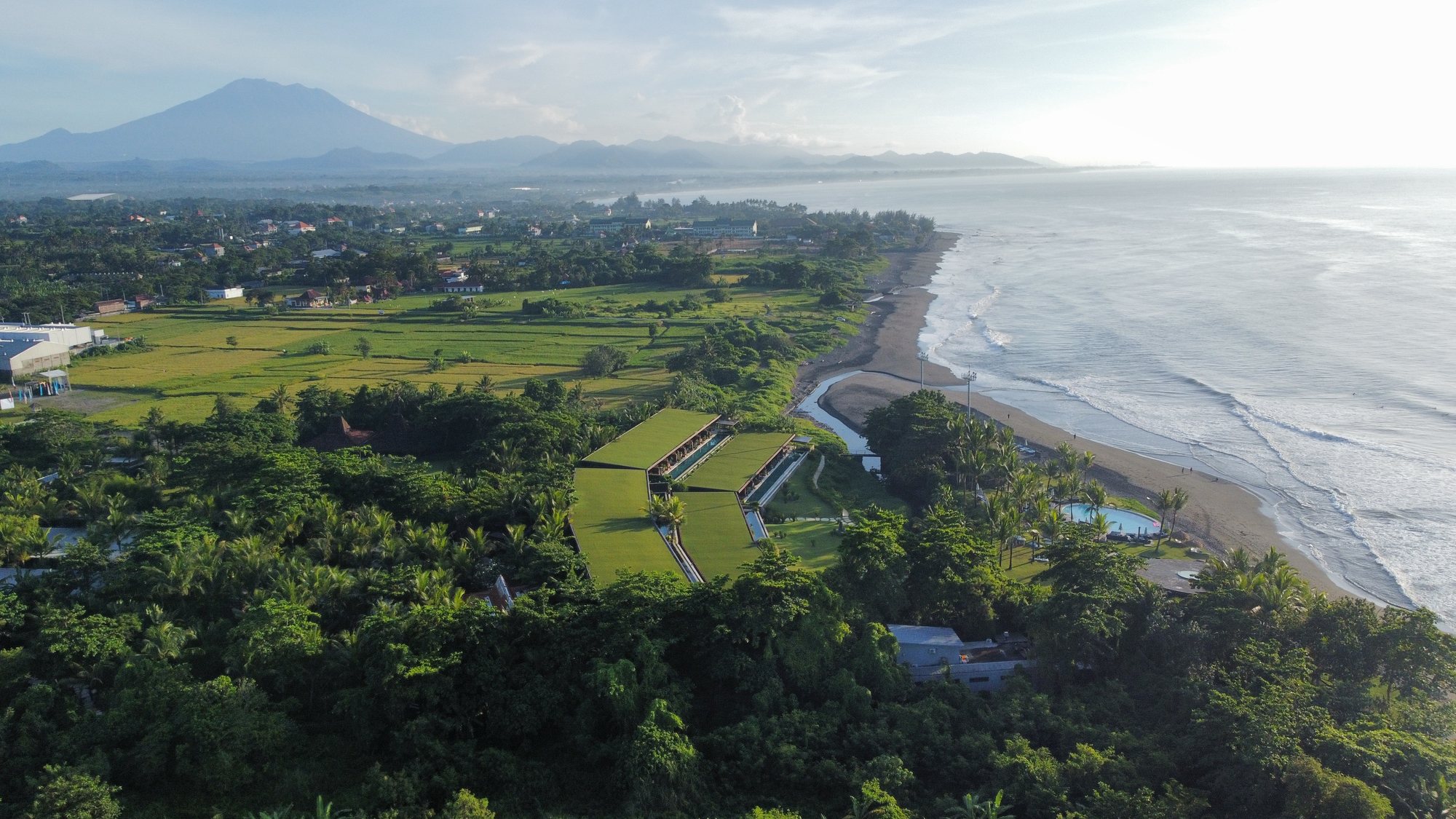
Plate IThe property at first light. Mount Agung in the distance, the Keramas reef to the right, the resort in its grove.MMXXVI
There is a road that runs along the east coast of Bali, north out of Sanur, and after about forty minutes the rice fields open up and the air changes and you start to hear the surf before you see it. Keramas is one of those breaks that announces itself. A long-period right that fires on the dry-season swells and produces, on its best days, the kind of wave that sponsors fly people across the world to ride. The Komune resort sits directly above it, looking down on the reef from a low headland, and has done so for the better part of fifteen years.
What has happened on that headland in those fifteen years is the subject of this piece. The resort was built, in the beginning, as a surf-and-wellness proposition — a place to come, surf the wave, and recover well enough to surf it again the next morning. That was the brief. What was not in the brief, and what has emerged over the long arc of the property's life, is a body of work that now looks much more like a longevity practice than a wellness resort. The new additions to the property make this explicit. The medical wing being built next to them makes it permanent.
I. The break
The case for Keramas, if you are a surfer, is that the wave is serious. It is not a wave you ride casually. It runs fast, it tubes early, it punishes hesitation. The dry-season swells produce a right-hander that is, on its day, the closest thing in Bali to a contest-grade racetrack. The WSL has held qualifying events here. The training camps come through in the lead-up to the championship tour. There is a reason the wave is on the bucket list of every serious surfer in the southern hemisphere, and a reason a few of them stay for a week and end up coming back for a month.
The case for Komune, alongside the wave, is that the resort has been built and operated by people who understand what the wave demands. The founder, Tony Cannon, is a long-time surfer. The original partner, Luke Egan, is a former world tour competitor. The first generation of the property's regulars included names that are still on the cover of The Surfer's Journal — Tom Carroll, Joel Parkinson, half a dozen others who have spent enough time on the wave to know what the body needs after a session on it. The resort's wellness offering was built, originally, to keep them in the water.
"The wave is the engine. The recovery is what keeps the engine running. Everything we have built since is downstream of that idea."
— from a conversation with a member of the team
That distinction — the engine and the recovery — is, more than anything, the reason the property has aged into what it now is. Most surf resorts have a gym and a spa and call it a wellness offering. Komune was, almost from the start, building something more specific. The Joglo Spa came first, then the gym, then the beach club. Each of these is well-handled in its own right. None of them, in isolation, explains why the resort has become the place that practitioners of the long career — the surfers still in the water at fifty and sixty — quietly book their off-seasons.
II. What gets built when surfers run a resort
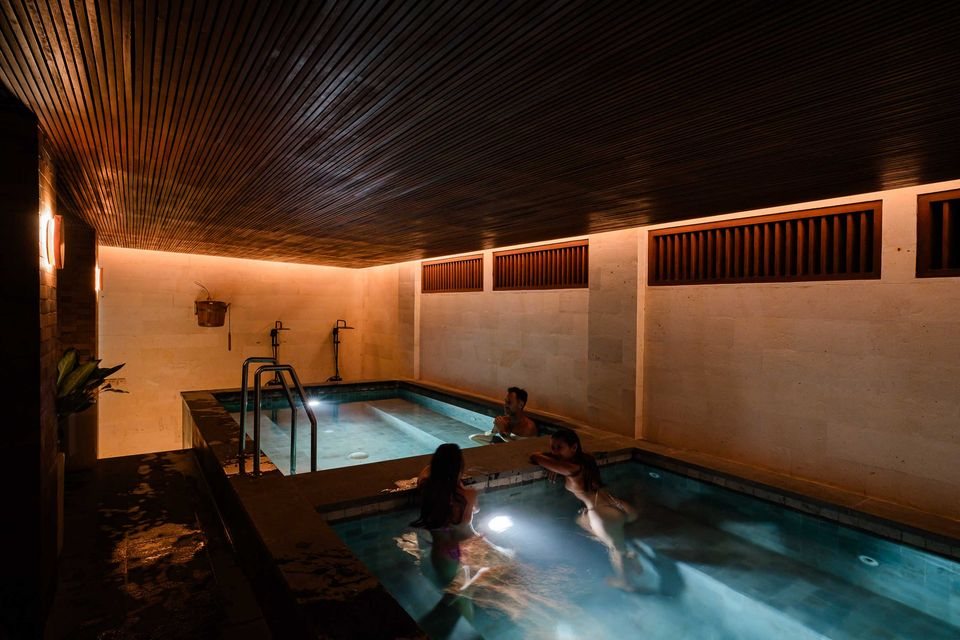
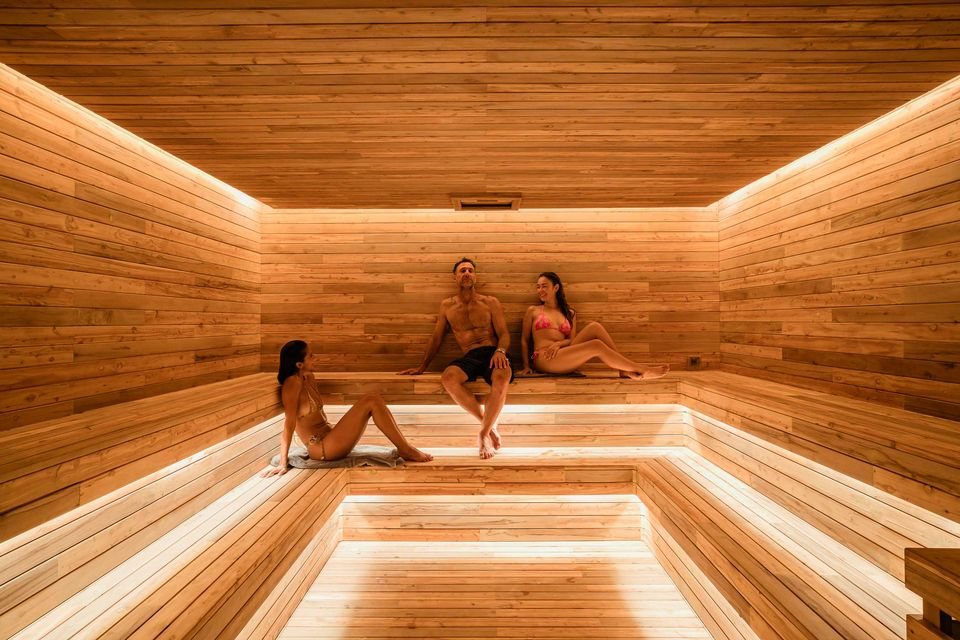
The most recent additions to the property are the easiest place to see the practice in its mature form. There is a new recovery centre, sited next to the beach club, behind sandstone walls and a slatted teak ceiling. It runs the standard contemporary stack — a cedar sauna with light-strip benches and a single porthole vent, a plunge that holds at two degrees, and a magnesium spa that has been arrived at, by trial and error rather than spec sheet, at the temperature the resort's longest-staying guests have settled on. The three-modality circuit — hot, cold, magnesium — has become the default closing ritual of a Komune training day. Most guests, after the first week, find themselves doing it without thinking.
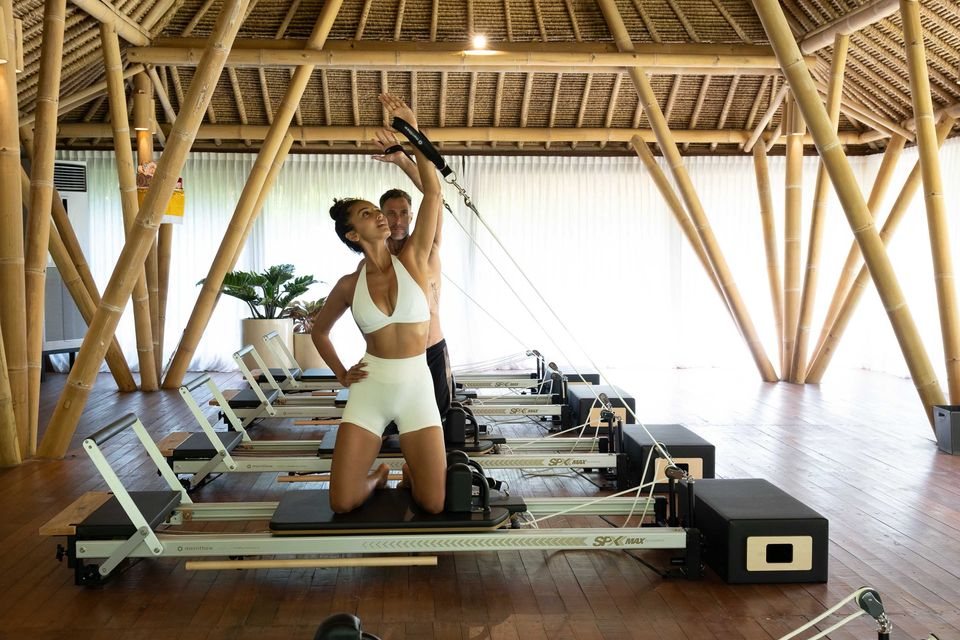
Adjacent to the recovery centre is the new Pilates studio. It runs the full Merrithew reformer programme — SP MAX apparatus across a row of stations, on a roster of certified instructors, in a bamboo-trussed open pavilion that sits in its own grove behind the main resort. The decision to license the Merrithew curriculum — over the cheaper option of running an unbranded reformer class — was made for the same reason most of the rest of the property has been built: that the practitioners who use the resort would notice the difference. A Pilates studio that is not credentialed is, to the people for whom this matters, a Pilates studio that is not credentialed. To everyone else, it is invisible. The credentialing is the practice.
Plate IIThe Pilates studio. SP MAX Merrithew apparatus, bamboo trusses, dark floor, sheer curtains drawn against the heat.MMXXVI
The new gym sits between the studio and the recovery deck. It is not a hotel gym. The flooring is sprung. The free weights run to where they need to run. The cardio bank is small and well-chosen. There is a TRX wall, a sled track, a stack of Olympic plates, and a pair of GHD benches that have been there long enough to have nicknames. Nothing about the room is decorative. It is a room that was specified by people who lift, and used by people who lift, and the difference is felt in the first ten minutes of being in it.
III. The Bunker
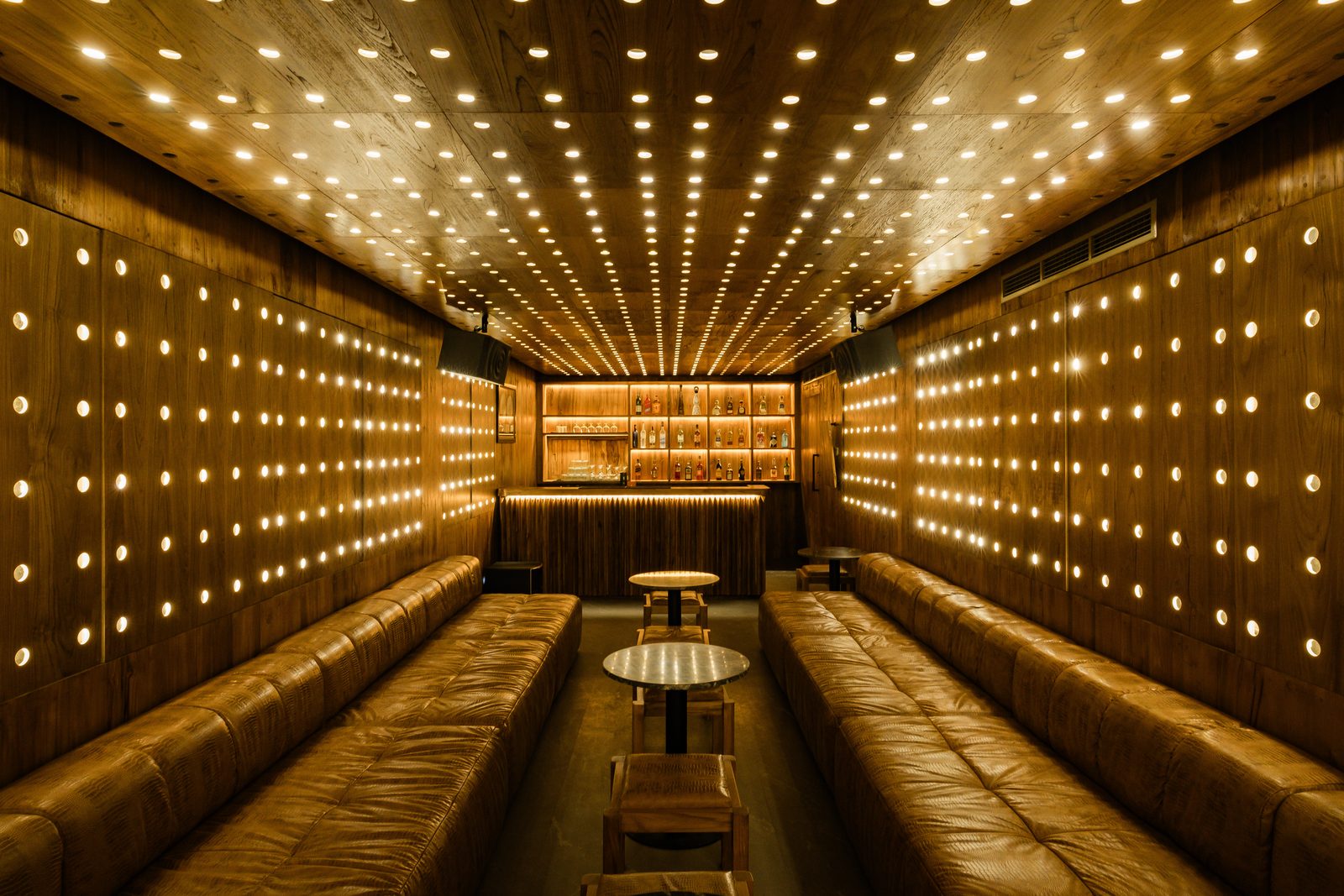
The piece of the property that does not look, at first, like part of a longevity practice — and which is, on a second look, the part that holds the whole practice together — is the YLB Bunker. The Bunker is a private karaoke lounge on the lower level of the resort, behind a door that is not on the property map. The walls and ceiling are pricked with hundreds of small bulbs set into the teak panelling — a constellation in a wooden box. Two long banquettes in tan leather face each other across the room. A bar at the rear, well-stocked, mostly in agave. The song catalogue runs from 1972 to roughly last Tuesday. It is, as a member of the team described it, a place of utter joy and happiness, and it serves a specific function in the design of the retreats: it is the closing ritual.
A discipline-and-release structure. The cold plunge in the morning. The Bunker at night. The point is not the singing. The point is that the week ends in a room where no one is watching the clock.
— Albe* note · April MMXXVI
The case for a Bunker, in a longevity practice, is the case for closing the loop. Most wellness retreats end on a meditation, a juice, and a flight home. The bodies have done the work. The nervous systems have not been told the work is over. The Komune retreats end in the Bunker — the same group who arrived at the airport not knowing each other's names, now standing on banquettes singing songs that were on the radio when they were fifteen. It is the part of the week that is not about discipline, and it is the part of the week that makes the discipline stick. Recovery without joy is just maintenance.
Plate IIIThe YLB Bunker. Teak panelling, a constellation of bulbs, two banquettes, a bar mostly in agave. The closing room.MMXXVI
IV. The clinic, in build
The next addition to the property is not yet open. A medical and longevity clinic is currently under construction at the upper end of the resort, with an opening window in the second half of MMXXVI. When it opens, it will run the diagnostic and intervention stack that has, in the last five years, moved from boutique American clinics into the mainstream of high-end wellness — VO2 max testing, full in-body composition scanning, continuous cardiac and blood-pressure monitoring, IV nutrient and rehydration protocols, and a single-person hyperbaric chamber sited in its own room at the rear of the building.
The clinic is not, in itself, the story. Equipment of this kind has been available, in one form or another, in any number of longevity centres in Bangkok, Singapore, and the more serious of the Bali clinics, for several years. What is different at Komune is what it is being built next to. A clinic on its own measures things. A clinic that opens onto a recovery deck, a Pilates studio, a sprung-floor gym, and a wave that demands eight hours of effort a day, measures things and has somewhere for the measurements to go. The numbers from the morning's VO2 test become the inputs for the afternoon's session. The DEXA scan becomes the programming brief for the week.
The integration is the point. Most longevity clinics in the region are standalone — a building, a car park, a return appointment in six weeks. Komune is building one inside a working practice, which means the data does not sit in a folder. It moves through the week.
V. The Perez programme
The other piece that is new is the partnership with Rod Perez. Perez is the longevity specialist who has, for the better part of a decade, been the trainer of record for some of the longest careers in Australian surfing — Tom Carroll, Joel Parkinson, the founder of the resort himself among them. His method, in the broadest terms, is a long-arc strength-and-mobility practice built for athletes who intend to keep going long after the contest tour ends. The practitioners who use him do not advertise the fact. The careers do the advertising.
From late MMXXVI, Perez will run a series of programmed retreats at Komune across the next twelve months — a quarterly calendar of small-group cohorts, each one anchored around a featured guest from his roster. Luke Egan and Joel Parkinson are confirmed for the first two intakes. The format runs five mornings of the diagnostic and movement work that Perez is known for, five afternoons in the water, and the recovery stack between them. The closing night, in each retreat, is in the Bunker.
"If you want to keep surfing at sixty, you have to start training for it at forty. We had been doing this for our own bodies for years. We have decided to open the door."
— Tony Cannon · April MMXXVI
The point worth making, about a programme of this shape, is who it is for. It is not for the wellness tourist. It is for the practitioner — the surfer, the climber, the cyclist, the swimmer, the lifter — who has a thirty-year career in a sport behind them and intends to have a thirty-year career in the same sport ahead of them. The training is not soft. The intent is not aesthetic. The whole project is downstream of one question — what does it take to keep going — and the answer at Komune, after fifteen years of doing it for themselves, is the version of the answer the property is now opening to a wider list.
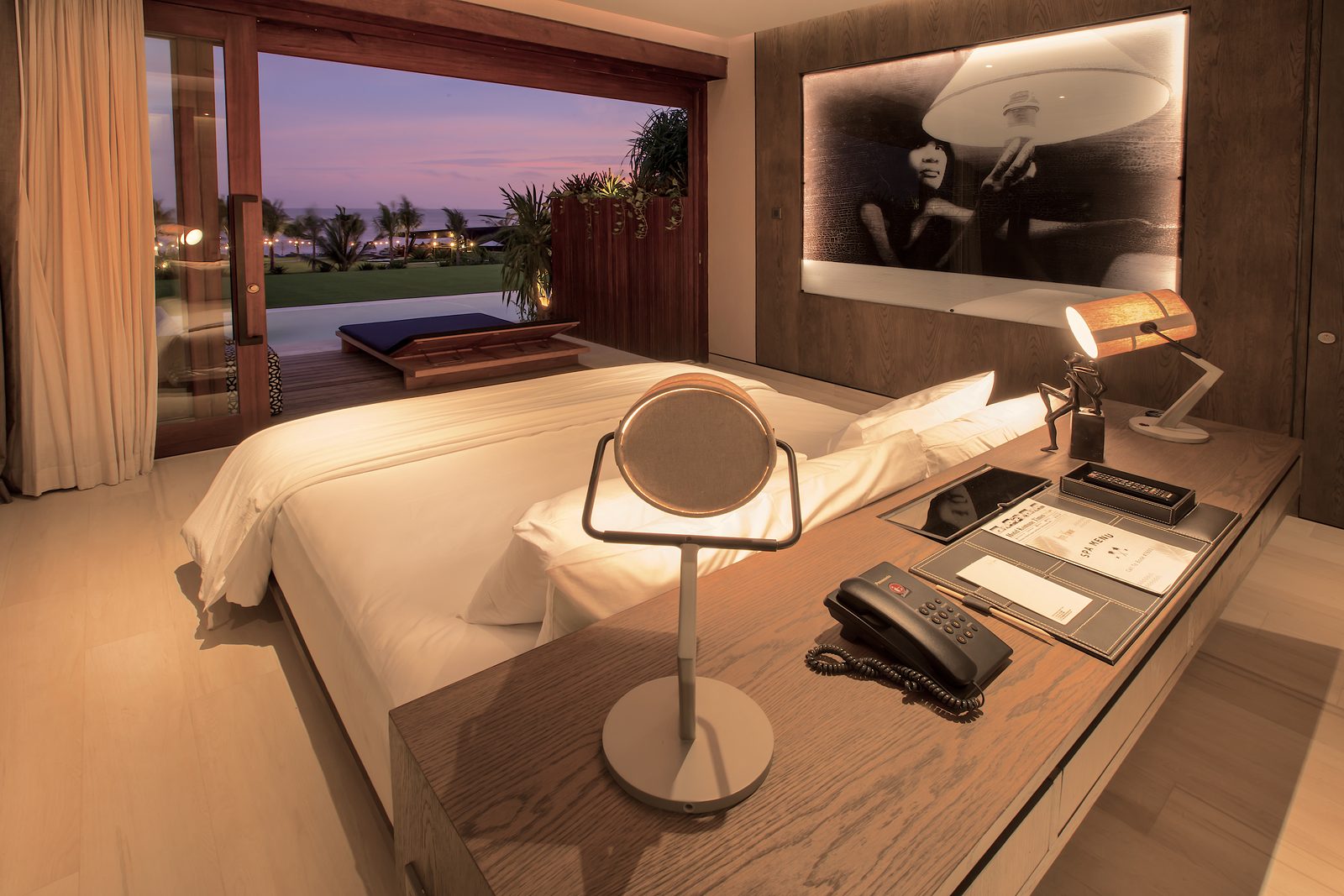
Plate IVA suite at dusk. The doors open to the lawn and the pool, and beyond them the line of the surf at last light. The room the day ends in.MMXXVI
VI. What the long ride shows
The case for Komune, finally, is not a wellness case. The sauna and the plunge are well-built, but plenty of resorts in Bali have a sauna and a plunge. The clinic, when it opens, will run a stack that several other clinics in the region also run. The Pilates studio is licensed, the gym is well-specified, the Bunker is a good Bunker. None of these, on its own, would be the reason to write the piece.
The reason to write the piece is that the property has been built, over fifteen years, by practitioners — for practitioners — in a place that demands practice. The founder trains under his own trainer at his own resort. The first generation of guests are still on the booking calendar in their fifties and sixties. The longest careers in Australian surfing have, almost without exception, passed through Keramas for a stretch. The new wing is not the start of a longevity practice at Komune. It is the formalisation of the one that has been quietly running since the resort opened.
On the last evening of a retreat in April, the closing dinner was set up on the beach club lawn, between the recovery deck and the line of the surf. The sun went down behind us. A few of the guests had been at the morning's VO2 session and were comparing their numbers across the table. Two of them were going to be in the water at six the next morning. One of them, a former world tour competitor, was going to be in the Bunker until late, and then in the water at seven, and then on a flight to Sydney by the afternoon. He had been doing this, in one form or another, for thirty years. He intended to do it for thirty more.
The wave was still up below us. The recovery deck was lit. The clinic was a building site at the other end of the property, a few months from opening, the rebar still showing in places. The Bunker was somewhere behind us, and one of the staff was checking the lights. The long ride was the long ride.
That is the story. The resort was built fifteen years ago to keep a small group of surfers in the water. It has done that, and along the way, it has built the equipment, the staff, the rooms, the programme, and the practitioner partnerships to do the same for a much wider list. The new wing makes it official. The wave, in the meantime, is still where it has always been.
*
— The House
Hotel Komune Bali
Keramas, Gianyar
East Coast, Bali
Indonesia