Issue Nº01 · Long Read Nº II
Albe* — A Public Relations Practice
*
Featured Piece · Nº II · The Long Read

The long view.

On Bingin Hill, a cluster of four modern-Mediterranean villas makes the case for the long stay. A note on Villa Zyloh, the way it is built, and the way the hill rewards anyone who stays long enough to feel it.

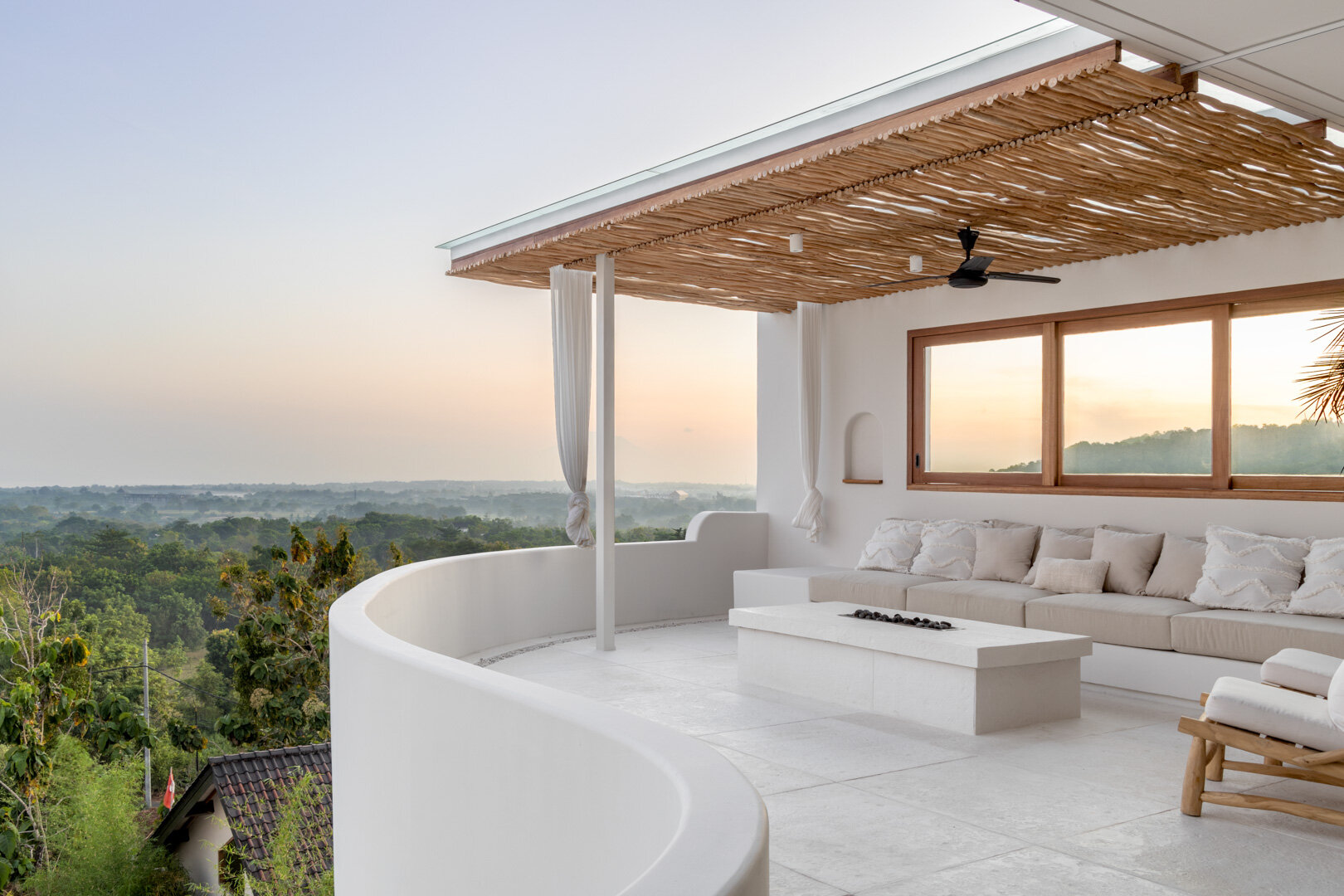
The upper balcony at Villa Zyloh at sunset — curved white plaster walls, woven driftwood ceiling, the fire pit and the long view west over the Bukit
Plate IThe upper balcony, looking west at last light. The curved wall, the woven ceiling, the long view. MMXXVI

There is a road that runs south from Jimbaran through Pecatu and ends, eventually, at the lighthouse on the cliffs at Uluwatu. Halfway along it the land starts to lift. The motorbikes thin out. The signage gets quieter. The road bends and the air changes and you are, without quite noticing, somewhere else. They call this part of the island the Bukit. The people who live here call it the hill.

Villa Zyloh sits on the hill. Not at the top of it — at the top, the road runs out and you find the temple. Not at the bottom — at the bottom, the road runs out and you find the surf. Zyloh sits in between. A small cluster of villas, modern Mediterranean in architecture, looking west over a long stretch of ocean that has, on most evenings, no horizon at all — just a graduation of orange into pink into the line where pink stops.

I. The hill

Bingin is one of those places that resists description because what is striking about it is also what is hardest to photograph. The cliffs are not the highest in Bali. The surf below is not the most famous. The view is not the widest. But there is something in the geometry — the way the land falls away, the way the road runs along the spine of the headland, the way the temples sit at the top and the breaks at the bottom and the villas, the cafés, the studios sit in the long middle band where the wind comes off the water and the people who came once tend to come back.

This is not new. The Bukit has been the long view of Bali since the Australians started arriving in the seventies. Padang Padang. Uluwatu. Dreamland before Dreamland became a name. Bingin in particular has been a slow burn — a place spoken about quietly, by people who would rather it not get too loud. For thirty years it stayed that way. Then in the last decade the road got better, the cliffs got built, and the hill became what it is now: a village of villas and food and small studios run by people who came for a season and forgot to leave.

"Zyloh is not a hotel. It is a house. The longer you stay, the more you understand the difference." — Wayan, host

Zyloh was built into that village in 2022. The land had been sitting unused for the better part of a decade — a steep parcel facing west, with a view that any developer in the area would have built on years earlier if the access had been easier. When the access did finally improve, four villas went up in a single season. They share a design language, a staff, and a hill. Beyond that, they are distinct buildings, intended for distinct guests.

II. Modern Mediterranean

The choice of architecture is worth pausing on, because it is not obvious. Bali is, by long convention, an alang-alang and teak proposition. The thatch roof. The dark hardwood floor. The carved gateway. There is a reason for this — it works in the heat, it works in the rain, it sits in the landscape — but it is also a habit, and most new builds on the Bukit have been some variation of it for two decades.
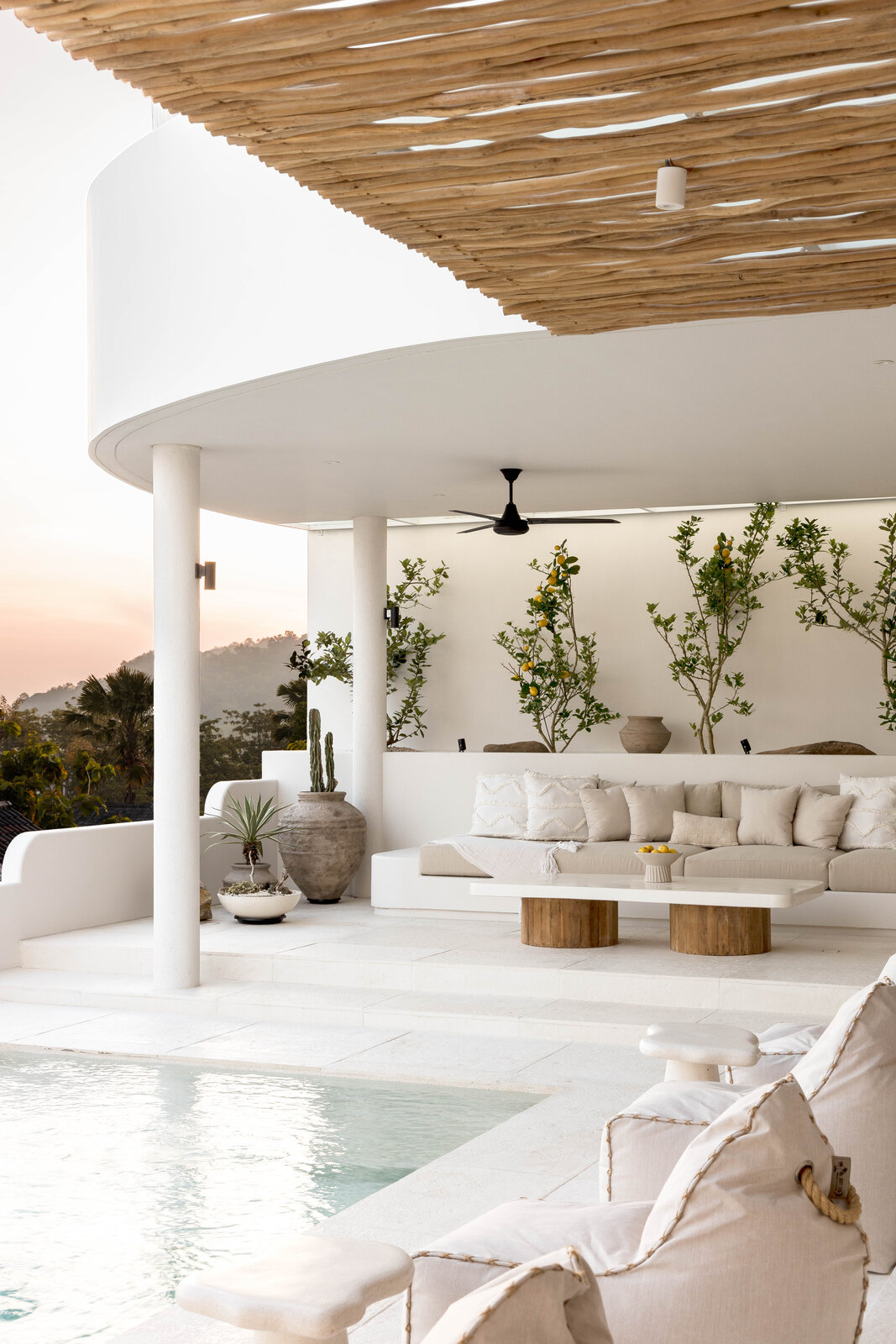
The pool terrace at Villa Zyloh — citrus trees in old terracotta urns, white linen sofas under a woven driftwood pergola, the salt-water pool in the foreground
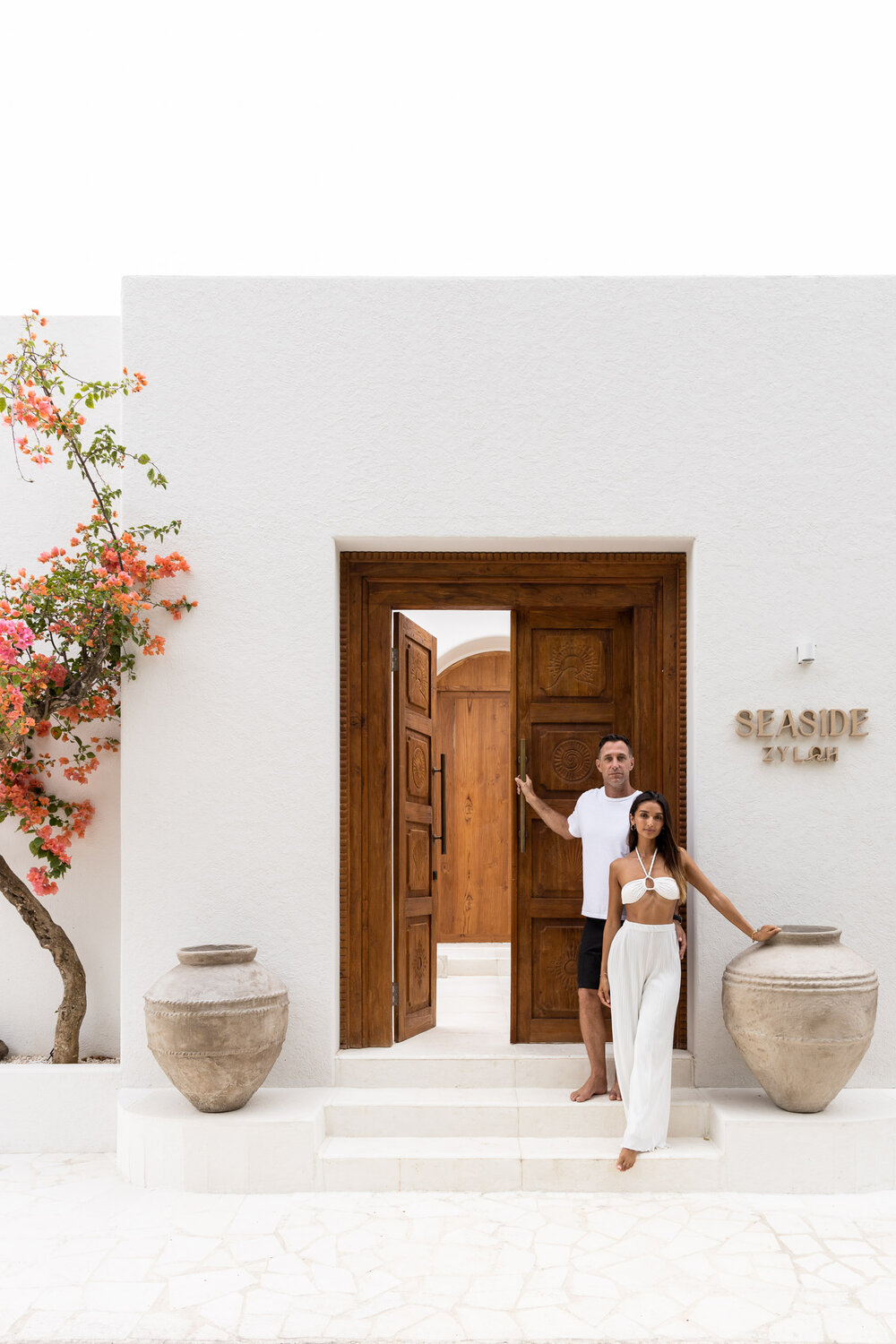
The entrance to Seaside Zyloh — carved teak doors, white stucco, bougainvillea, large terracotta urns at the threshold

Zyloh is not. Zyloh is white stucco, arched openings, terracotta tile, brass fittings. The shapes are Mediterranean — vaulted ceilings, narrow corridors that open into wide rooms, curved walls where there might have been corners, water everywhere because the architecture knows what to do with it. It could be on a hill in Mallorca. It could be on a clifftop in Antiparos. It is, in fact, on a road that runs to a Hindu sea temple, and the disorientation that produces — Mediterranean light, Indian Ocean below — is the whole point.

The architect drew from the Cycladic vocabulary and the Italianate one in roughly equal measure. The arches read as Italian. The white plaster reads as Greek. The terracotta floors are both. The brass is Spanish. None of these references is heavy-handed. The villa is not trying to be anything in particular, just to use a different vocabulary in a place where everyone else has been using the same one. You notice the difference immediately. You stop noticing it after about an hour. And then the building works on you.

III. Four addresses, one hill

There are four Villa Zyloh properties on the parcel, configured to suit four different kinds of stay. They share staff and infrastructure. Beyond that, they are distinct.

Zyloh Mansion is the largest — three bedrooms, two salt-water pools, a cinema room, the long balcony, the upper terrace with the fire pit. It is the configuration that gets booked for weddings, for families, for the groups who arrive on a Friday and stay for ten days. The rate sits at the upper end of Bingin and the booking calendar reflects it. There are four months in the year when it is impossible to get.

Zyloh Sunset is the three-bedroom, set on the parcel that catches — as the name suggests — the precise angle of the late-afternoon light. The balcony is the most photographed feature in any of the four villas. Most evenings, by six o'clock, the guests have arranged themselves on it with a drink, and no one moves until dark.

Zyloh Seaside is the smaller two-bedroom, with an infinity pool that drops away into the line of the cliff. It is, in many respects, the most architectural of the four. The BBQ terrace and the ocean view do the work that a hotel restaurant might, without any of the noise. It has been on the Homes To Love and Real Living lists for two seasons running.
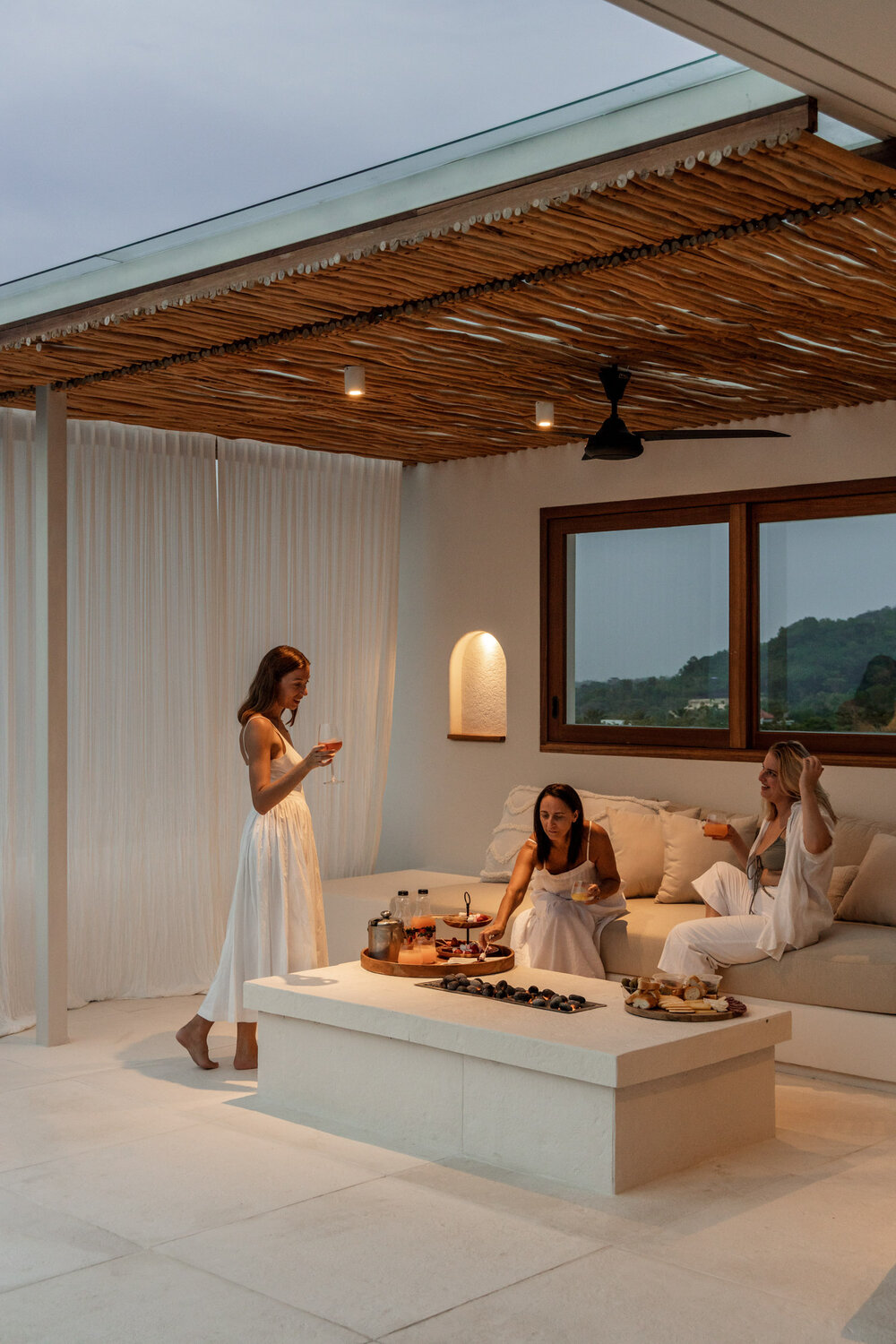
An evening on the upper terrace at Villa Zyloh — guests gathered around the fire pit at dusk, food and wine on a stone table, the woven ceiling lit from within
Plate IV An evening on the upper terrace. Most evenings, by six o'clock, the guests have arranged themselves around the fire pit, and no one moves until dark. MMXXVI

Zyloh Suite is the one-bedroom. It is the address that the long-stay guests take — the writer who is finishing a book, the surfer who is sitting out a season, the couple between leases — and it has, by some quiet margin, the highest rate of repeat bookings of the four. People come for a week and stay for six.

The four villas are operated as a single house, by a single team, with a single ledger. Guests in any of them can use the staff of any of them. The pools are shared if requested and private if not. The result is a property that behaves like a small hotel but reads like a private house, which is the configuration the hill seems to prefer.

IV. The host

Wayan has been hosting on the Bukit for eleven years. He started before Bingin had a name. He took on Zyloh when the build finished and has run it, with a team of nine, ever since. The team are local. Most of them have been with him from the beginning. There is no front desk. There is, in the morning, a tray of fruit on the kitchen counter and a note in handwriting saying which staff member is on for the day and what their phone number is, which most guests do not need to use, because the staff appear at the door before the guest has thought to call them.

This is the part of the operation that is hardest to describe in a brochure and easiest to feel inside an hour of arriving. The villa is well-built and well-finished and the architecture does most of the work, but what carries a guest through the long stay — the four-night booking that becomes a ten-night booking — is the team. The arrival is unhurried. The meals appear when they are wanted and not when they are not. The staff know which guest is sleeping in and which guest is going to be down at the surf at six in the morning. By the third day, the difference between the villa and a private house belonging to a friend has narrowed to the point of irrelevance.

"What do you want people to know about Zyloh?" we asked. "That it's a house. Not a hotel." — from a conversation in March MMXXVI

Wayan does not give interviews. He talks to journalists, when he talks to them at all, in passing — when they happen to be staying as guests. This piece is one of those. We were there for six nights in March. He cooked the third dinner himself, in the outdoor kitchen on the upper terrace, and stayed for half a glass of wine, and answered three questions, and then went home to his own family on the other side of the hill.

V. What the long view shows

The case for a place like Zyloh is not, finally, an architectural one. The arches and the terracotta tiles are well-handled, but plenty of villas on the Bukit are well-handled. The case for Zyloh is that it has been built and operated in a way that rewards the long stay. The four nights that become ten. The week that becomes a month. The single visit that becomes the annual visit.

A short stay in Bali — three nights, four nights — tends to feel like a transaction. The check-in, the resort, the breakfast buffet, the spa, the check-out. The clock is always running. Almost everything you do is something you have paid for, in cash or in time, and the moment you stop paying, you have to leave.

The longer stay is different. The longer stay is what the hill has always been for. The houses on the Bukit are not built for the long weekend. They are built for the time it takes to forget what day it is, to recognise the staff, to know which beach has the wind in the morning and which has the wind in the afternoon, to find a coffee shop that becomes your coffee shop, to take the same walk three times. Zyloh has been built and operated for this kind of stay. It is, you might say, the configuration the architecture was always pointing to.

On our last night the team set up dinner on the upper balcony — the one with the fire pit, the one that catches the last of the light. Some other guests came up from the lower villa for a drink. Wayan was not there, but his staff were, and someone had cut strawberries, and the conversation slowed down the way conversations slow down when the day has been long enough.

The view was the long view, the one the villa is named for, in a sense. The horizon was gone by half past six. The temples on the cliff above us were already in the dark. The surf below us was still up. We sat on the balcony until ten, and then we went to bed, and we slept the way you sleep on a hill that has been a hill for a thousand years.

The architecture is well done. The team is excellent. The location is among the best in Bali. But what you remember, when you leave, is that you were on the hill, and you stayed long enough to feel it, and the villa was built and run by people who knew that the long stay was the point. That is what the long view shows.

*

— The House

Villa Zyloh
Bingin Hill, Pecatu
Bukit Peninsula
Bali, Indonesia

— By Reservation

villazyloh.com
Four villas — Mansion, Sunset, Seaside, Suite
Long stays preferred

— Press & Trade

For press enquiries, editorial commissions, and trade rates:
press@albe.press
Represented by Albe*